


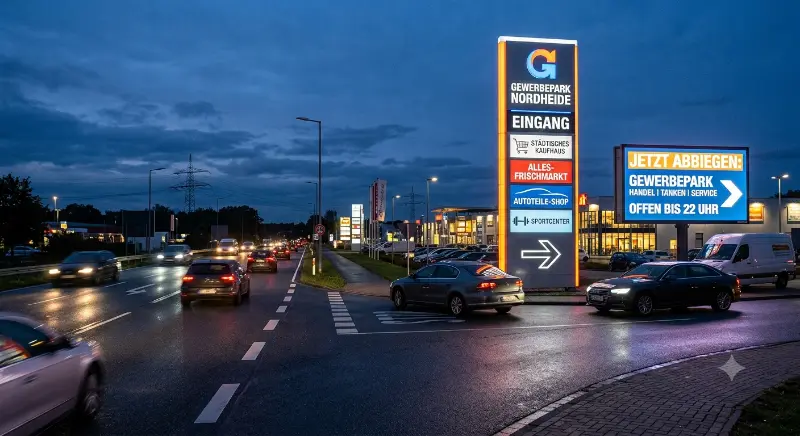
Seek and ye shall find. In our private lives, this saying may sound appealing. For businesses, business parks, industrial estates and branch locations, however, being difficult to find is a real problem. When suppliers miss the turn-off, new customers have to make uncertain U-turns or job applicants cannot find the entrance, it costs time, patience and trust.
Strategically planned outdoor signage makes all the difference here. It combines visibility, wayfinding and project-for-mer-in-kaiserslautern/" class="kb-auto-link">brand impact into a clear system. Your business is noticed from the road, visitors are guided safely onto the premises, and every interaction begins with a professional first impression.
Why visibility from a distance is so important for signage
Visibility from a distance describes how well a sign, a pylon or an illuminated advertising display can be seen and understood from a greater distance. Every second counts, particularly on roads, access roads, in industrial estates or on extensive company premises. Road users need to be able to quickly identify where your site is located and which entrance is the correct one.
Professional outdoor advertising from Light and Sign fulfils three key functions:
- It makes the location visible from a distance.
- It helps visitors find their way around at an early stage.
- It strengthens the brand’s presence in public spaces.
Many companies invest heavily in modern buildings, well-maintained outdoor areas and high-quality reception areas. However, if the signage by the roadside is too small, poorly positioned or unlit, much of this impact is lost. Visibility does not begin at reception, but on the way there.
From the road to the entrance: a good wayfinding system is designed in stages
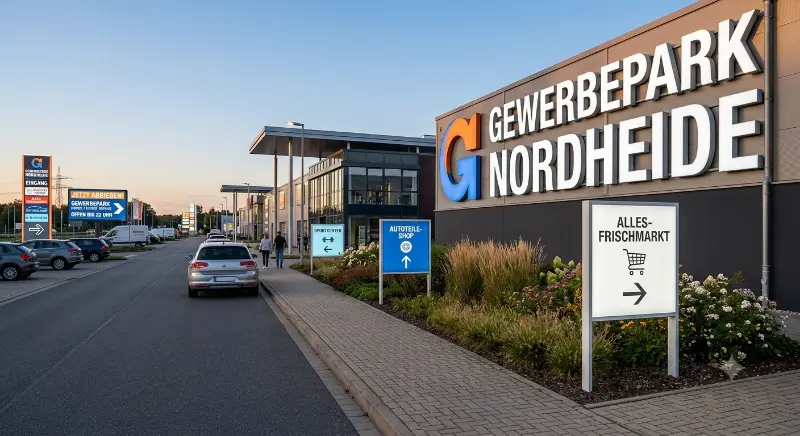
An effective wayfinding system does not begin at the factory gate. It guides visitors step by step from the public transport area to their exact destination on the site.
Stage one: Visibility to road users
On main roads, access roads or in industrial estates, there is often very little time to take in a message. Travelling at 50 kilometres per hour, a vehicle covers almost 14 metres per second. That is why signage must be clear, large enough and well positioned.
Pylons, large company signs, façade lettering and illuminated advertising displays are particularly well suited to this initial point of contact. They create a strong visual presence, mark the location and ensure that visitors can react in good time.
Stage Two: A clear lead at the entrance
Once visitors have reached the entrance, the purpose of the signage changes. The focus is now less on simply attracting attention and more on providing guidance. Signs indicating ‘Visitors’, ‘Deliveries’, ‘Collections’, ‘Administration’, ‘Parking’ or ‘Goods Receipt’ must be easy to understand at a glance.
A well-planned signage system clearly separates information from one another. This reduces unnecessary enquiries, dangerous manoeuvres and traffic caused by people searching for their way around the site.
Stage 3: Finding your way around the company premises
On the site itself, a logically structured system of signposts, information pillars, car park signs, door signs and, where necessary, floor markings is required. This level of signage ensures safety and efficiency, particularly at industrial sites, logistics centres, car showrooms, hotels, clinics and larger office complexes.
Signage should always be in keeping with the architecture, the corporate design and the actual use of the site. This is the only way to create a harmonious overall impression.
What elements create a strong visual impact from a distance
Effective signage rarely consists of a single sign. In most cases, the best results are achieved through a combination of several coordinated elements.
| Element | Task | Typical place of use |
|---|---|---|
| Advertising pylon | High visibility and site marking | Property boundary, driveway, road |
| Facade signage | Brand impact and orientation from a distance | Main building, halls, entrance areas |
| Lightbox | Visibility by day and by night | Facade, cantilever, entrance area |
| Guide | Traffic management and practical information | Access roads, junctions, car parks |
| Stealing | Guidance on an equal footing | Entrances, reception, visitor areas |
| Door signs | Attention to detail in the building | Entrances, offices, function rooms |
Light boxes and LED products, in particular, ensure that a location remains clearly visible even in the dark, in the rain or during the darker months of the year. Modern LED technology combines high luminosity with high efficiency and a long service life.
Readability determines impact
A sign may be of high quality but still fail to serve its purpose if it is difficult to read. The key factors for visibility from a distance are font size, contrast, viewing angle and the amount of information.
Good signage provides quick answers to the most important questions:
- Am I in the right place?
- Where do I need to go?
- Where am I allowed to drive or park?
- Where is the entrance?
The quicker these questions are answered, the better the system works.Je schneller diese Fragen beantwortet werden, desto besser funktioniert das System.
Font size and distance
The required font size depends heavily on the viewing distance. A sign that is read from a distance of 10 metres requires different proportions to a pylon that is intended to be visible from as far as 80 or 100 metres away. When planning, it is worth consulting the recommendations on font size and legibility set out in DIN 1450.
In practice, the following applies: the higher the speed and the greater the distance, the clearer, larger and simpler the design must be.
Contrast and colour effects
Strong contrasts improve readability. Dark text on a light background or light text on a dark background usually works much better than subtle tone-on-tone combinations. Corporate design remains important, but should always be balanced against readability.
With outdoor advertising in particular, colours must look good in daylight, under artificial lighting, at dusk and in bad weather. That is why a real-world site test is so valuable.
Less information, more guidance
Too much content makes signage difficult to understand. A clear message is often sufficient for visibility from a distance: a logo, company name or main function. Detailed information should be included at the next level of the wayfinding system.
A signpost by the roadside doesn’t have to explain everything. It has to make things visible, confirm them and guide people.

Planning sightlines correctly
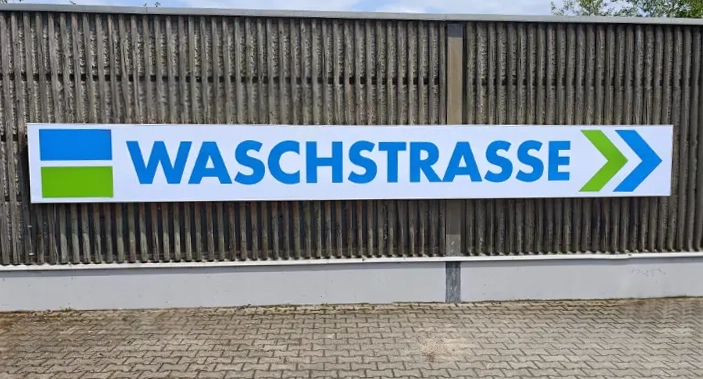
Even the best advertising display is of little use if it is obscured. Trees, parked vehicles, neighbouring buildings, bends, street lamps or other companies’ advertising spaces can obstruct the view.
That is why planning should always be based on the actual directions of approach. It is not just a question of where the sign looks good, but from where it needs to be seen.
Key points to check are:
- From which direction do customers, suppliers and staff come?
- When will the installation be visible?
- How long will she remain in view?
- Are there any obstacles in summer or winter?
- Is the signage visible even in the dark?
- Is there any glare or distracting reflections?
On this basis, the size, position, orientation and lighting concept are determined.
Safety on the premises
Signage is not just advertising. It also contributes to safety. Particularly in areas where cars, lorries, forklift trucks, pedestrians and visitors come together, signage must provide clear guidance.
For internal traffic routes, the BGHM’s guidelines on the marking of traffic routes can serve as a useful basis. It is important to have clearly visible markings, a clear separation between vehicle lanes and footpaths, and clear signage to guide users in situations where visibility is poor.
A good wayfinding system reduces risks, takes the pressure off staff and ensures that visitors can move around safely.
Technical requirements for outdoor signage
Outdoor signage is exposed to wind, rain, sun, frost and temperature fluctuations on a daily basis. That is why choosing the right materials and ensuring professional installation are so important.
Tried-and-tested materials include, for example, aluminium, stainless steel, acrylic glass, composite panels and weather-resistant films. For illuminated installations, LED modules, power supplies, control systems and ease of maintenance also play an important role.
Permits should also be checked at an early stage. Depending on the size, location, lighting and local building regulations, an advertising structure may require a permit. Further information on this can be found in the Light and Sign article on the permit requirements for advertising structures.
Sustainability and efficiency with modern LED technology
Moderne Außenbeschilderung soll nicht nur sichtbar sein, sondern auch wirtschaftlich und nachhaltig funktionieren. LED Technik bietet dafür klare Vorteile. Sie ermöglicht eine gleichmäßige Ausleuchtung, lange Lebensdauer und einen deutlich effizienteren Betrieb als viele ältere Beleuchtungssysteme.
Using twilight sensors, timers or smart control systems, the lighting can also be adjusted to actual requirements. This ensures visibility is maintained whilst reducing energy consumption and operating costs.
To complement this, Light and Sign provides information on sustainable lighting solutions and efficient LED technology for outdoor advertising.
Planning with Light and Sign: From site assessment to installation
Effective signage does not happen by chance. It is the result of design, technology, site analysis and skilled craftsmanship.
Light and Sign supports companies from the initial idea right through to the finished installation. This includes consultancy, design, technical planning, production, delivery, installation and, on request, assistance with all aspects of planning permission and structural requirements.
Effective signage does not happen by chance. It is the result of design, technology, site analysis and skilled craftsmanship.
Thanks to our offices across Germany, projects can be planned and implemented nationwide.
Conclusion: Good signage makes businesses visible and accessible
Professional signage with high visibility from a distance is more than just a decorative feature. It serves as a guide, a brand ambassador and a factor in efficiency all at once.
It ensures that customers, suppliers, job applicants and business partners can find your company more quickly, navigate it with greater confidence, and perceive your premises as well-organised and professional from the very first moment.
Those who plan signage strategically gain visibility, reduce search-related traffic and strengthen their brand in public spaces.
Would you like to modernise your outdoor signage or plan a new wayfinding system for your premises? If so, please get in touch with Light and Sign. Together, we’ll develop a solution that ensures visibility, provides clear guidance and delivers lasting results.