



Why light captures our attention
intelligent-led-technology-from-specialist-retailer-light-and-sign-gmbh/" class="kb-auto-link">Light not only plays a visual role for humans, it also influences perception, attention and cognitive processes. Numerous scientific studies show that light intensity, colour temperature and spectral composition have a direct influence on alertness, concentration and performance.
Studies on illuminance show that a vertical illuminance of around 1000 lux on the eye promotes attention significantly more than lower values of around 200 lux. In addition, recent studies show that brightness and colour temperature have a measurable influence on cognitive performance, for example in memory tasks or reaction tests, depending on the time of day and the environment.
Reviews on the effects of daylight and artificial intelligent-led-technology-from-specialist-retailer-light-and-sign-gmbh/" class="kb-auto-link">light also come to a clear conclusion. Short-wave, blue-enriched white light in combination with high light intensity can increase concentration, memory performance and problem-solving abilities.
Conclusion:
Light is not only used for visibility. It specifically activates visual and cognitive processes in the brain. This is precisely where the potential of modern illuminated advertising lies, as used, for example, in professionally implemented LED illuminated advertising systems or high-quality profile letters.
Illuminated advertising Attention and recall
In the field of outdoor advertising, studies clearly show that illuminated advertising spaces are superior to static and unlit advertising.
A study on the influence of design aspects of illuminated advertising analysed the viewing behaviour of passers-by in a pedestrian zone using eye tracking. The result is clear. Illuminated advertising systems such as profile letters, LED signs or light boxes attract significantly more attention and are better remembered than comparable non-illuminated advertising media.
Furthermore, it became clear that light alone is not the decisive factor. Design, colour, brightness and the spatial context have a significant influence on effectiveness. This is precisely where modern lighting design comes in, combining technical precision with brand impact.
Conclusion:
Illuminated advertising increases both the likelihood of being noticed and the chance of being remembered in the long term. Professional outdoor advertising, such as individually designed advertising installations, thus creates a measurable advantage over traditional solutions.
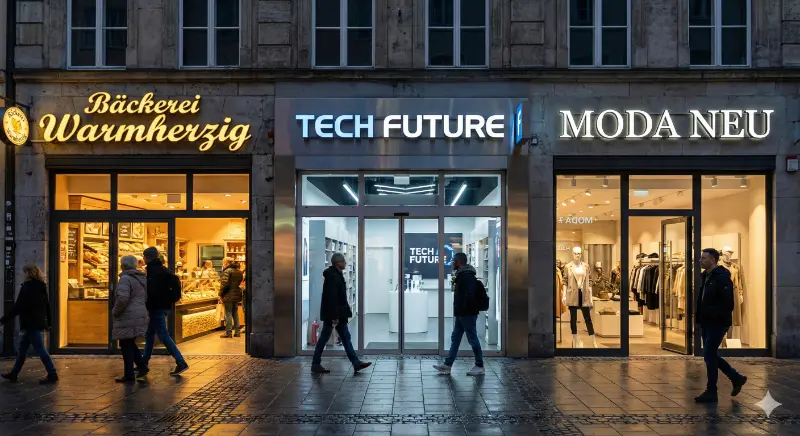
Colour psychology and the atmospheric effect of light
Light does not only affect us through its brightness. Colour, light temperature and spectral composition influence mood, behaviour and well-being.
The so-called non-visual effects of light include effects on the circadian rhythm, hormone balance and general well-being. Warm light is often perceived as calming and inviting, while cool white light conveys clarity, alertness and modernity.
These effects also play a central role in the design of illuminated advertising. Depending on the industry, location and target group, specific emotional or functional effects can be achieved.
Conclusion:
The choice of colour and light temperature in illuminated advertising is not purely a stylistic device. It influences how high-quality, safe or inviting a company is perceived to be and how strongly people remember a brand.
Lighting design and timing When illuminated advertising is most effective
Clear recommendations for practice can be derived from the interplay of physiological, cognitive and psychological effects.
Brightness and contrast
Illuminated advertising has maximum impact at dusk and in the dark. The strong contrast to the surroundings ensures high visibility, especially for outdoor advertising in busy locations.
Colour choice and light temperature
Warm light is particularly suitable for catering, service and lifestyle brands. Cooler light signals clarity, modernity and technological competence, for example in fashion or technology companies.
Time control
Illuminated advertising is particularly effective from dusk until the evening hours, when the natural light-dark contrast is high and many people are out and about.
Design and dynamics
Even without aggressive animations, differentiated brightness levels or subtle changes in lighting can enhance perception. Modern LED solutions enable precise control while offering high energy efficiency.
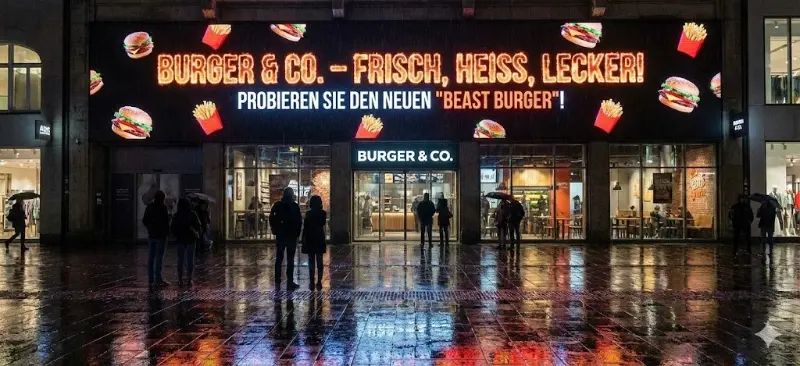
Conclusion Why illuminated advertising is a strategic lever
Scientific findings clearly show that light can do much more than just make things visible. It directly influences attention, mood and memory performance.
Companies that use lighting in a targeted manner, taking into account brightness, colour temperature, contrast, environment and timing, create a sustainable competitive advantage. Professionally planned illuminated advertising thus becomes a strategic communication tool that strengthens brands, provides orientation and remains in the memory for a long time.
The interplay between design, technology and sustainability demonstrates why modern illuminated advertising is now a key component of a strong brand image.